
New text element
Tuesday, June 2, 2026
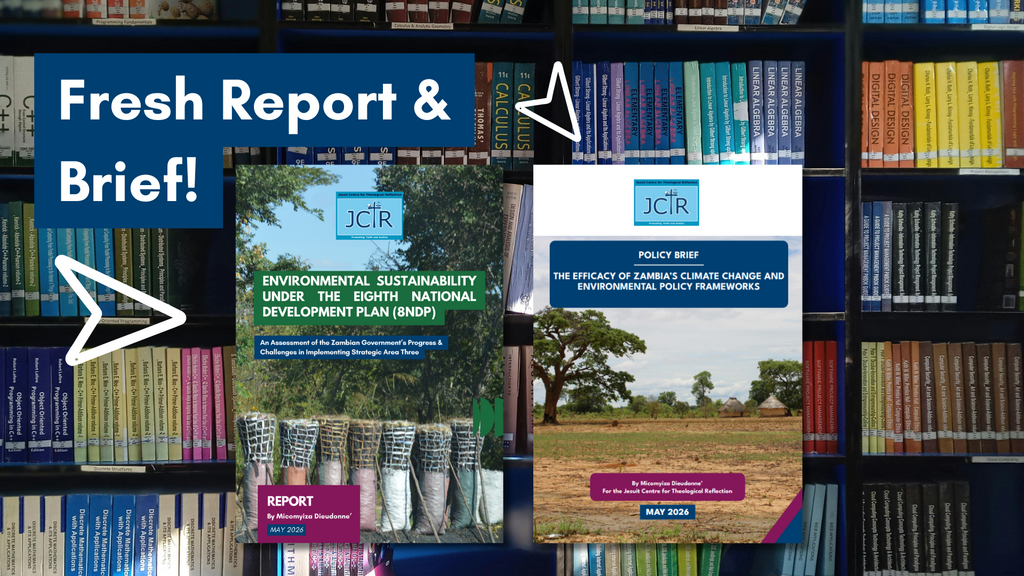
The Jesuit Centre for Theological Reflection (JCTR), with support from Misereor, has released two important publications examining Zambia's environmental sustainability agenda and climate governance landscape. Together, The Efficacy of Zambia's Climate Change and Environmental Policy Frameworks and the Environmental Sustainability 8NDP Implementation Review 2026 provide a timely assessment of the country's progress, challenges, and opportunities in responding to climate change and environmental degradation.
As Zambia continues to experience prolonged droughts, devastating floods, deforestation, land degradation, biodiversity loss, and increasing pressure on natural resources, the need for effective climate action has never been more urgent. The two publications offer a critical reflection on whether existing policies and development commitments are translating into meaningful outcomes for communities most affected by climate change.
Climate change remains one of the greatest threats to Zambia's socio-economic development. Rising temperatures, erratic rainfall patterns, recurring droughts, and floods continue to undermine food security, livelihoods, energy production, and economic growth.
Recognising these challenges, Zambia has developed a wide range of policy instruments and legal frameworks, including the National Policy on Climate Change, National Adaptation Plan, Nationally Determined Contributions (NDCs), National Green Growth Strategy, Environmental Management Act, Forestry Act, and other sector-specific frameworks. These policies are complemented by the environmental sustainability commitments outlined in the Eighth National Development Plan (8NDP), which positions climate resilience and environmental stewardship as critical pillars of national development.
The central question explored by both publications is whether these frameworks are sufficiently effective in delivering tangible results for vulnerable communities and safeguarding Zambia's natural environment.
The reviews reveal that Zambia has made notable progress in strengthening environmental governance and integrating climate considerations into national planning processes.
One of the most significant achievements has been the establishment and operationalisation of the Ministry of Green Economy and Environment, which has elevated climate and environmental issues within government structures. The ministry has improved coordination among sectors such as agriculture, energy, water, forestry, and mining while strengthening Zambia's participation in regional and global climate processes.
The country has also made important strides in aligning national development priorities with international commitments under the Paris Agreement and the Sustainable Development Goals. Climate considerations are increasingly being mainstreamed into planning and budgeting processes across key sectors.
Regulatory institutions such as the Zambia Environmental Management Agency (ZEMA) have strengthened environmental monitoring, inspections, licensing procedures, and Environmental Impact Assessment systems. Efforts to combat illegal logging and promote compliance with environmental regulations have also expanded.
On the ground, climate adaptation and resilience-building initiatives have gained momentum. Programmes promoting climate-smart agriculture, conservation farming, crop diversification, ecosystem restoration, and watershed protection are helping communities respond to changing climatic conditions.
The implementation of the Great Green Wall Initiative and the adoption of the National Green Growth Strategy (2024–2030) further demonstrate Zambia's commitment to restoring degraded ecosystems, promoting sustainable land use, and pursuing a greener economic future.
Despite these achievements, both publications highlight a persistent implementation gap between policy ambition and practical outcomes.
The assessment of Zambia's climate and environmental policy frameworks found that while the country possesses a robust architecture of policies, strategies, and plans, implementation remains constrained by several systemic challenges.
One of the most significant gaps is the absence of comprehensive climate change legislation that provides clear legal mandates, institutional responsibilities, enforcement mechanisms, and accountability frameworks.
Institutional fragmentation continues to affect coordination among ministries and agencies. Overlapping mandates and weak coordination mechanisms often undermine effective implementation and monitoring.
Environmental programmes also remain underfunded. While climate change and environmental sustainability are increasingly recognised as national priorities, budget allocations remain insufficient compared to the scale of the challenges facing the country. This has resulted in heavy dependence on donor funding and project-based financing models, which can limit long-term sustainability.
The Environmental Sustainability 8NDP Review identifies inadequate and unpredictable financing as one of the greatest barriers to effective implementation. Environmental programmes continue to receive a relatively small share of national resources, limiting the government's ability to scale up climate adaptation, ecosystem restoration, environmental monitoring, and enforcement activities.
At the same time, many institutions responsible for environmental governance face shortages of skilled personnel, operational resources, transport, laboratory facilities, and digital monitoring systems. These limitations weaken enforcement efforts, delay compliance inspections, and reduce the effectiveness of environmental management interventions.
Private-sector investment in green technologies, renewable energy, and climate innovation remains below potential, despite growing opportunities within Zambia's green economy transition.
While policies and programmes are expanding, environmental degradation continues to accelerate in many parts of the country.
Deforestation remains a major concern, driven largely by charcoal production, agricultural expansion, and illegal timber harvesting. High dependence on biomass energy continues to place enormous pressure on forest ecosystems.
Climate-related disasters are also becoming more frequent and severe. Recent droughts have reduced agricultural productivity and affected hydropower generation, while flooding has displaced communities and damaged infrastructure. Weak enforcement of environmental regulations, particularly within high-risk sectors such as mining, continues to raise concerns about environmental accountability and corporate responsibility.
The reports also highlight the slow pace of decentralisation, which limits the ability of local authorities and communities to participate meaningfully in environmental governance and climate adaptation planning.
A key message emerging from both publications is that effective climate action requires stronger community participation.
Communities are often the first to experience the impacts of climate change, yet they are frequently excluded from policy formulation and implementation processes. The reports call for greater recognition of traditional knowledge systems, stronger engagement with traditional leaders, and enhanced support for community-driven climate adaptation initiatives.
The publications also highlight the importance of successful community-based models such as JCTR's Community Action on Climate Change Adaptation and Environmental Management Project, which is being implemented with support from Misereor in Southern, Western, and Luapula Provinces. The project empowers communities with knowledge, skills, and advocacy tools to engage duty bearers and influence climate and environmental policy processes.
The findings point towards several priority actions for government, development partners, civil society, communities, traditional leaders, and the private sector.
These include fast-tracking comprehensive climate change legislation, increasing and stabilising climate financing, strengthening institutional capacity, accelerating decentralisation, improving environmental monitoring and enforcement systems, expanding climate-smart agriculture and renewable energy investments, and strengthening accountability within the extractive sector.
There is also a need to improve environmental data systems, support evidence-based decision-making, and foster stronger collaboration among government institutions, civil society organisations, communities, and private-sector actors.
Zambia has established a strong policy foundation for climate action and environmental sustainability. However, the country's ability to achieve meaningful and lasting results will depend on its capacity to move from policy commitments to effective implementation.
The two JCTR publications remind us that climate resilience cannot be achieved through policy documents alone. It requires adequate financing, stronger institutions, community ownership, political commitment, and sustained collaboration among all stakeholders.
With continued support from Misereor, JCTR remains committed to advancing climate justice, environmental sustainability, and people-centred development, ensuring that the voices of vulnerable communities remain at the centre of Zambia's environmental future.

"A just Zambian society guided by faith, where everyone enjoys the fullness of life".