
Lusaka, Zambia | 24 November 2026
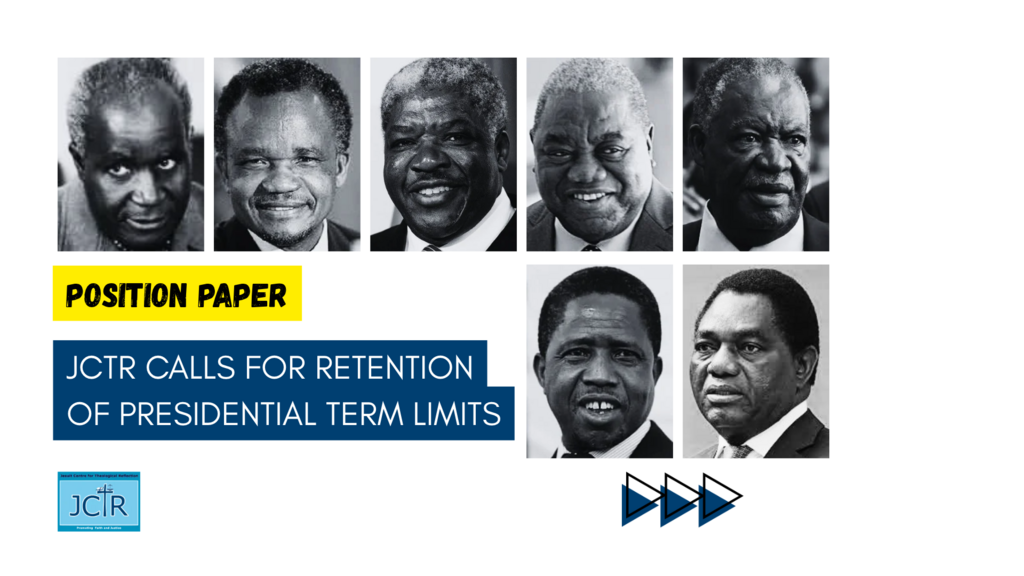
The Jesuit Centre for Theological Reflection (JCTR) has called for the retention of Zambia's presidential term limits and the existing five-year presidential tenure, warning that removing these constitutional safeguards could weaken democratic accountability, undermine leadership renewal and increase the concentration of political power.
In a new position paper titled Position Paper on Proposals to Remove Presidential Term Limits and Extend Presidential Tenure, JCTR argues that presidential term limits are essential institutional safeguards that promote constitutionalism, peaceful leadership succession and the common good.
The position comes amid renewed public debate over proposals to abolish the two-term presidential limit and extend the presidential term beyond the constitutionally established five years.
Presidential term limits are a constitutional safeguard
Article 106(3) of the Constitution of Zambia provides that a person who has twice held office as President is not eligible for election as President. Article 106(1) establishes a five-year presidential term.
JCTR maintains that these provisions do not undermine citizens' democratic right to elect their leaders. Rather, they establish constitutional boundaries on the exercise of executive power and ensure that leadership renewal remains a predictable feature of democratic governance.
The Centre observes that Zambia's constitutional history provides important lessons on the dangers of excessive concentration of political power. Following the restoration of multiparty democracy in 1991, presidential term limits became part of the country's constitutional framework, reflecting the importance of competitive elections and peaceful transfers of power.
The debate is therefore not simply about whether citizens should be free to choose their preferred presidential candidate, but also about the constitutional safeguards necessary to protect democratic choice.
Zambia's history offers important lessons
JCTR draws attention to Zambia's experience under the one-party political system between 1972 and 1991, when presidential tenure was not constitutionally limited. The Centre also recalls the 2001 debate surrounding former President Frederick Chiluba's attempt to secure a third term, which prompted significant mobilisation by churches, professional associations and civil-society organisations under the Oasis Forum.
These historical experiences demonstrate the importance of maintaining institutional safeguards that prevent the excessive concentration of political power.
The Centre further notes that constitutional safeguards must apply consistently, regardless of which political party occupies Government. It would be contradictory for political actors who previously defended presidential term limits to advocate their removal once in power.
Constitutionalism and the common good
Drawing on Catholic Social Teaching, JCTR argues that public authority must be exercised in service of the common good and the dignity of the human person.
The Centre references Pope John Paul II's Centesimus Annus, which recognises democracy as a system that enables citizens to participate in political decisions, hold their leaders accountable and replace them through peaceful means.
The position paper also draws on the work of Jesuit priest Fr Leonard Chiti, who describes the common good as the conditions of social life that enable people to achieve their human development.
From this perspective, the presidency is a public office entrusted to an individual for the service of the people, rather than an entitlement belonging to the person occupying it.
JCTR therefore maintains that constitutional limits on presidential tenure are consistent with democratic participation and the principle that political authority must remain accountable and temporary.
Electoral fairness and the argument for continuity
Responding to arguments that citizens should simply decide presidential tenure through elections, JCTR emphasises that democratic choice requires a fair electoral environment.
The Centre points to findings from the European Union Election Observation Mission's 2026 final report, which identified incumbency advantages, an uneven electoral playing field and concerns about the impartiality of certain institutions.
JCTR's own monitoring of the 13 August 2026 general election, through 25 accredited monitors across seven provinces, also documented procedural concerns during the counting and closing stages of the electoral process.
The Centre further references findings from MISA Zambia's election media monitoring, which highlighted disparities in political coverage across public media platforms.
These findings, alongside recommendations from regional and international election observer missions, reinforce the need to strengthen electoral institutions and democratic accountability.
JCTR also challenges the argument that development requires continuity in the leadership of one individual. Sustainable development, it argues, should be anchored in strong institutions, effective policies and accountable governance rather than prolonged presidential tenure.
JCTR's recommendations
To safeguard Zambia's constitutional democracy, JCTR makes six key recommendations:
Protecting democracy beyond political interests
JCTR emphasises that its position is not directed at any particular President or political party. Rather, it is concerned with preserving the constitutional principles and institutions that safeguard Zambia's democratic future.
The Centre argues that removing presidential term limits or extending presidential tenure could weaken leadership succession, increase the personalisation of executive power and undermine institutional independence.
Ultimately, democratic stability is best secured through strong institutions, constitutional safeguards and predictable rules governing the exercise of political authority.
Zambia's democracy must be built on institutions that serve the people, not on the continued tenure of individuals.
Read the full position paper
For a more comprehensive examination of the constitutional framework, historical context, arguments surrounding presidential tenure and JCTR's recommendations, access the full position paper below.
Position Paper on Proposals to Remove Presidential Term Limits and Extend Presidential Tenure

"A just Zambian society guided by faith, where everyone enjoys the fullness of life".