
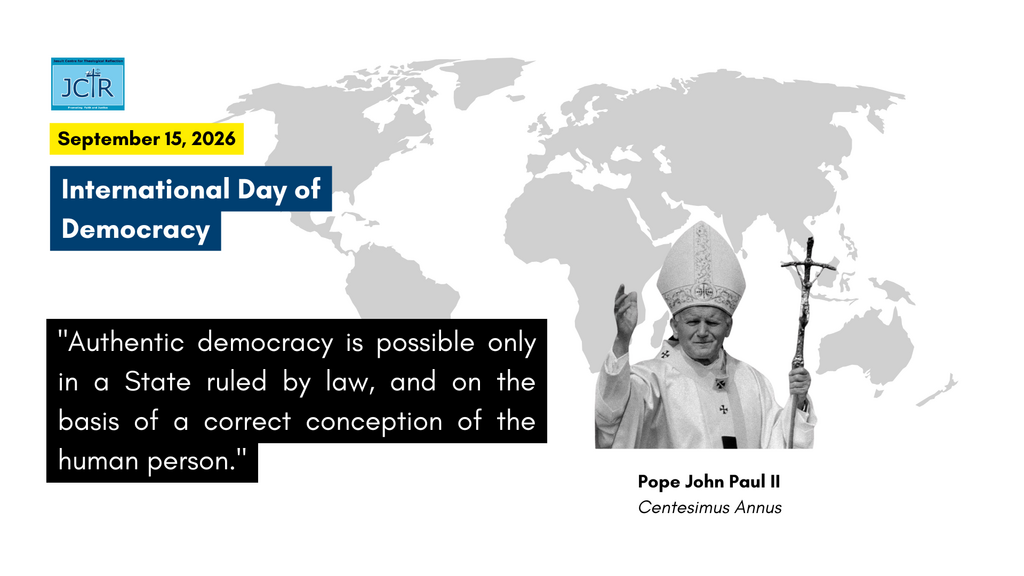
15 September 2026
Today, as we commemorate the International Day of Democracy, we are reminded that democracy is not merely a destination to be attained but an ongoing process that requires constant vigilance, renewal, and commitment. Democracy flourishes when citizens actively participate in public life, institutions remain accountable, and the rights and dignity of all people are protected.
Catholic Social Teaching offers timeless wisdom on the foundations of an authentic democracy. In his encyclical Centesimus Annus (§46), St. John Paul II highlights the importance of citizen participation and accountability in governance:
“The Church values the democratic system inasmuch as it ensures the participation of citizens in making political choices, guarantees to the governed the possibility both of electing and holding accountable those who govern them, and of replacing them through peaceful means when appropriate. Thus she cannot encourage the formation of narrow ruling groups which usurp the power of the State for individual interests or for ideological ends....”
This reflection invites us to consider three essential pillars of democratic life:
1. Citizen Participation and Accountability
A healthy democracy depends on the active involvement of citizens. Democratic governance is strengthened when people engage in public affairs, exercise their civic rights and responsibilities, and hold leaders accountable for their decisions and actions. Elections are important, but democracy extends beyond the ballot box. It requires continuous participation in shaping the future of our communities and nation.
2. The Rule of Law and Human Dignity
The rule of law is fundamental to democracy. It ensures that institutions function fairly, rights are protected, and power is exercised within established legal frameworks. Democracy can only thrive where justice, equality before the law, and respect for human dignity are upheld.
As Centesimus Annus further teaches:
“…Authentic democracy is possible only in a State ruled by law, and on the basis of a correct conception of the human person. It requires that the necessary conditions be present for the advancement both of the individual through education and formation in true ideals, and of the "subjectivity" of society through the creation of structures of participation and shared responsibility.”
Strong democratic institutions provide the conditions necessary for individuals and communities to flourish while safeguarding the common good.
3. Civic Education and Transparency
An informed citizenry is essential to democratic governance. Citizens need access to information, civic education, and transparent public institutions to meaningfully participate in public life. Understanding democratic structures, the responsibilities of leaders, and the rights and duties of citizens empowers people to make informed decisions and demand accountability.
Transparency and access to information also strengthen public trust and contribute to more responsive and effective governance.
A Call to Renew Our Democratic Commitment
As we mark the International Day of Democracy 2026, let us recommit ourselves to the values that sustain democratic life: active participation, accountability, respect for the rule of law, transparency, and civic responsibility.
Building a just and democratic society is a shared responsibility. Each of us has a role to play in strengthening the institutions and structures that protect human dignity, promote the common good, and ensure that democracy continues to grow in strength and integrity.
A just society is built when informed citizens participate, accountable leaders serve, and the rule of law protects the dignity of all.

"A just Zambian society guided by faith, where everyone enjoys the fullness of life".