
Friday, February 6, 2026
LUSAKA - The Jesuit Centre for Theological Reflection (JCTR), with support from the Scottish Catholic International Aid Fund (SCIAF), recently convened a National Media Training on Agroecology and Policy Reforms at its headquarters in Lusaka. The one-day training brought together journalists from various media houses to strengthen media capacity in reporting on agroecology, food justice, and the policy frameworks shaping Zambia’s food system.
The training forms part of JCTR’s Promoting Agroecology and Food Justice Project, which is being implemented in Lusaka, Southern, and Western Provinces. The project seeks to enhance public awareness, strengthen community advocacy, and influence policy and legislative reforms that support agroecological food production, climate resilience, and the protection of human dignity.
Why Media Matters for Food Justice
Opening the training, the Faith and Justice Programme Manager, Sr. Petronella Lyempe, emphasised the central role of the media in shaping public discourse and influencing policy priorities around food security and agriculture. She noted that Zambia is facing intersecting challenges of climate change, declining soil fertility, food insecurity, and mounting pressure on small-scale farmers.
Against this backdrop, agroecology offers a holistic and sustainable pathway. Beyond increasing yields, agroecology restores biodiversity, improves nutrition, strengthens local seed systems, and builds community resilience. Sr. Lyempe underscored that journalists are not only reporters of events, but key actors in informing, inspiring, and influencing national conversations on sustainable agriculture and food justice.
Building Policy Literacy and Accountability
A central focus of the training was the need for policy-literate journalism. Participants engaged with discussions on agricultural policies, legislative gaps, and implementation challenges that affect agroecological adoption in Zambia. The sessions highlighted how media scrutiny of agricultural budgets, subsidy programmes, food reserve management, and climate adaptation strategies can strengthen transparency and accountability.
By translating complex policies into accessible language, the media empowers citizens—particularly smallholder farmers, women, and youth—to understand their rights, engage in civic processes, and demand effective service delivery. This role is critical in ensuring that national policies move beyond written commitments to meaningful impact on the ground.
Amplifying Smallholder Farmers’ Voices
The training also emphasised the importance of amplifying the voices of smallholder farmers and marginalised communities, who remain under-represented in public debate despite being the backbone of Zambia’s food system. Journalists were encouraged to shift food narratives away from elite and technocratic perspectives towards stories grounded in lived rural realities.
Coverage that centres farmers’ experiences with subsidy programmes, climate shocks, market access, and sustainable practices provides invaluable feedback to policymakers. Such reporting strengthens downward accountability and ensures that food security debates are rooted in fairness, participation, and human dignity.
The Media and Agroecology
Facilitating the training, Micomyiza Dieudonné highlighted the media’s role in linking agroecology to both public awareness and policy reform.
“Agroecology must not remain a technical concept discussed only by experts. When journalists tell the stories of farmers practising sustainable agriculture and connect these experiences to policy choices, agroecology becomes visible, relatable, and actionable for both citizens and decision-makers,” he said.
Participants explored how reporting on practices such as intercropping, organic soil management, seed saving, and integrated pest management can validate local knowledge, encourage peer learning, and demonstrate that sustainable farming can improve resilience, nutrition, and livelihoods.
Towards a Just and Sustainable Food System
The training concluded with a call for continued collaboration between civil society, the media, and farming communities. Journalists were encouraged to pursue investigative, solutions-oriented, and inclusive reporting that keeps food security, climate resilience, and agroecology firmly on the national agenda.
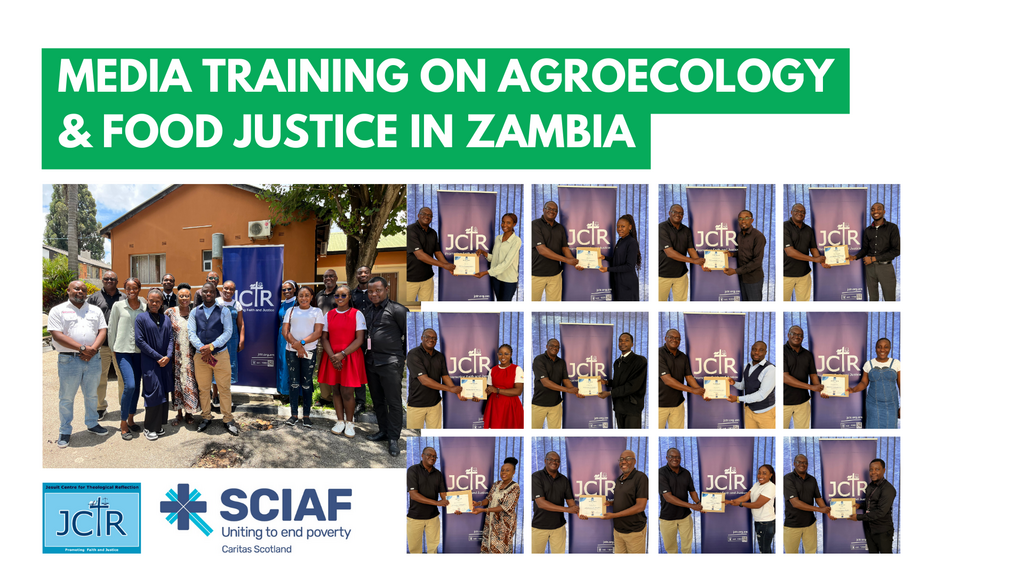
At the close of the session, participants were awarded certificates of participation by the Deputy Director, Rev. Dr. Boyd Kapyunga Nyirenda, S.J., in recognition of their commitment to advancing informed and responsible reporting on food justice issues.
Through sustained media engagement, JCTR’s Promoting Agroecology and Food Justice Project aims to contribute to a food system in which policies are accountable, communities are empowered, and agriculture supports both human dignity and environmental sustainability—today and for generations to come.
Below are images of our participants

"A just Zambian society guided by faith, where everyone enjoys the fullness of life".