
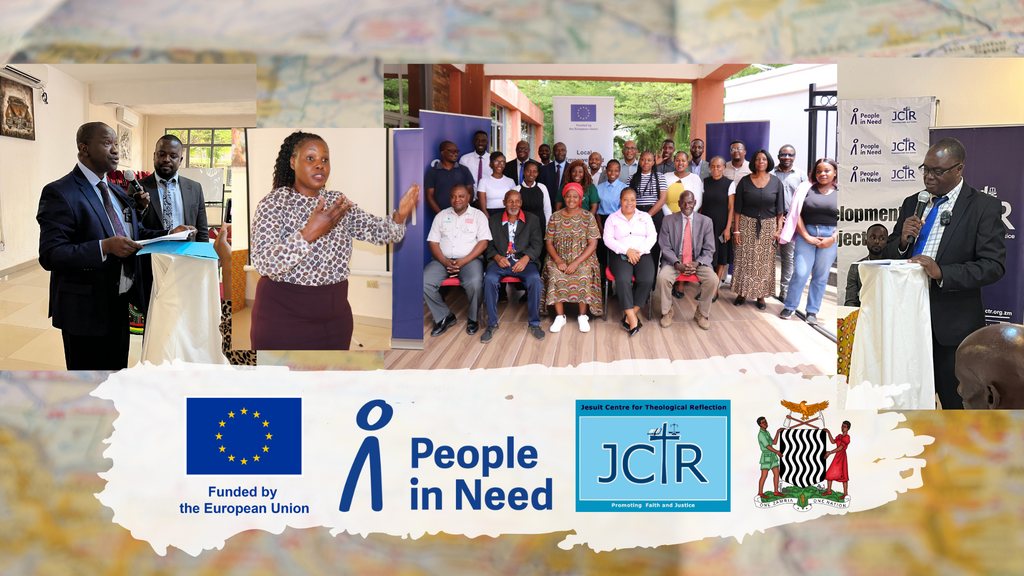
WEDNESDAY, 10 DECEMBER 2025, KAFUE - People in Need (PIN), in partnership with the Jesuit Centre for Theological Reflection (JCTR), has successfully concluded a series of high-level provincial stakeholder engagement meetings across Luapula, Southern, Western, North-Western and Lusaka Provinces, implemented under the CSO-LEADs Project with support from the European Commission.
These engagements brought together government, traditional leadership, civil society organisations (CSOs), cooperating partners, and private-sector actors to strengthen collaboration, enhance accountability, and advance inclusive, citizen-centred development across the country.
Speaking during the Lusaka engagement in Kafue, Lusaka Province Acting Permanent Secretary, Prof. Gideon C. Mwanza, reaffirmed government’s commitment to partnering with CSOs to promote democratic governance, social justice and sustainable development.
He commended CSOs for filling important gaps where government efforts may be limited, noting that “collaboration across sectors is essential for national development and for ensuring that the needs of citizens—especially the most vulnerable—are effectively addressed'.
Prof. Mwanza emphasised that the Government of the Republic of Zambia values structured engagement with the civil society sector and remains committed to fostering an enabling environment for its work.
Delivering the official welcome remarks, JCTR Deputy Director, Rev. Dr. Boyd Kapyunga Nyirenda, S.J., highlighted the indispensable role of CSOs in shaping Zambia’s development trajectory. Addressing government officials, traditional leaders, cooperating partners, civil society representatives and the media, he stated:
“This stakeholder and networking engagement is vital for civil society organisations in Kafue District and across Zambia, as it enables the pooling of resources, the sharing of knowledge and best practices, and the strengthening of our collective advocacy efforts.”
He underscored that networks and platforms enable CSOs to present a united voice capable of influencing policy and legislation, ensuring that marginalised groups remain at the heart of national development priorities.
Rev. Dr Nyirenda further stressed that such engagements build institutional capacity, prevent duplication, strengthen coordination, and contribute to a more resilient sector.
“Networking transforms a fragmented civil society into a cohesive, influential force—one that is better positioned to promote democracy, empower citizens and drive sustainable development in Zambia,” he noted.
He called on CSOs to uphold integrity, transparency, inclusivity and ethical conduct in all advocacy work, emphasising the need to create space for youth, women and persons with disabilities.
The Deputy Director also addressed the pressing need for legislation that protects the role and operating space of CSOs, particularly in an environment where mistrust of civil society work often persists.
“Together, may this engagement reaffirm our commitment to unity, integrity and shared purpose as we work toward a more inclusive and sustainable future for our communities,” he said.
During the engagement, Ms. Nora Nyirenda, Project Manager at People in Need (PIN), delivered a comprehensive presentation on the CSO-LEADs Project, outlining its core objectives, achievements and strategic direction.
She emphasised that the project, funded by the European Union and running from June 2024 to May 2027, aims to strengthen civil society actors so they can effectively participate in governance, policy dialogue and local development processes.
Ms. Nyirenda highlighted key elements of the project, including its focus on women, youth and marginalised group CSOs, the strengthening of internal management systems, and the promotion of linkages among CSOs, government, traditional leaders, the private sector and the media.
Her presentation outlined a series of early achievements, including:
Ms Nyirenda concluded by affirming PIN’s commitment to deepening collaboration with JCTR and local CSOs, noting that a resilient, well-coordinated civil society is essential for inclusive governance and sustainable development in Zambia. She invited participants to continue partnering with the CSO-LEADs Project in advancing accountability, transparency and civic engagement.
Across the five provinces, meetings were officiated by the respective Provincial Permanent Secretaries, signalling strong government endorsement of multi-sectoral cooperation.
Participants included:
This diversity ensured balanced discussions reflecting both policy perspectives and lived community experiences.
The engagements centred on building stronger, practical partnerships to advance accountability, transparency and improved service delivery. Key thematic areas included:
A major focus was shifting from isolated interventions to coordinated, cross-sectoral action—reducing duplication and promoting shared solutions.
All meetings emphasised the importance of centring development efforts on the needs and contributions of:
Stakeholders reiterated the need to expand civic space and empower communities not merely as beneficiaries but as active contributors to planning, oversight and decision-making.
The successful completion of the five provincial engagements reflects a growing commitment among stakeholders to work collaboratively to address systemic development challenges. The outcomes mark progress towards:
As the CSO-LEADs Project continues to unfold, PIN and JCTR reaffirm their commitment to strengthening civic participation, reinforcing partnerships, and supporting governance processes that are inclusive, transparent and sustainable.

"A just Zambian society guided by faith, where everyone enjoys the fullness of life".