
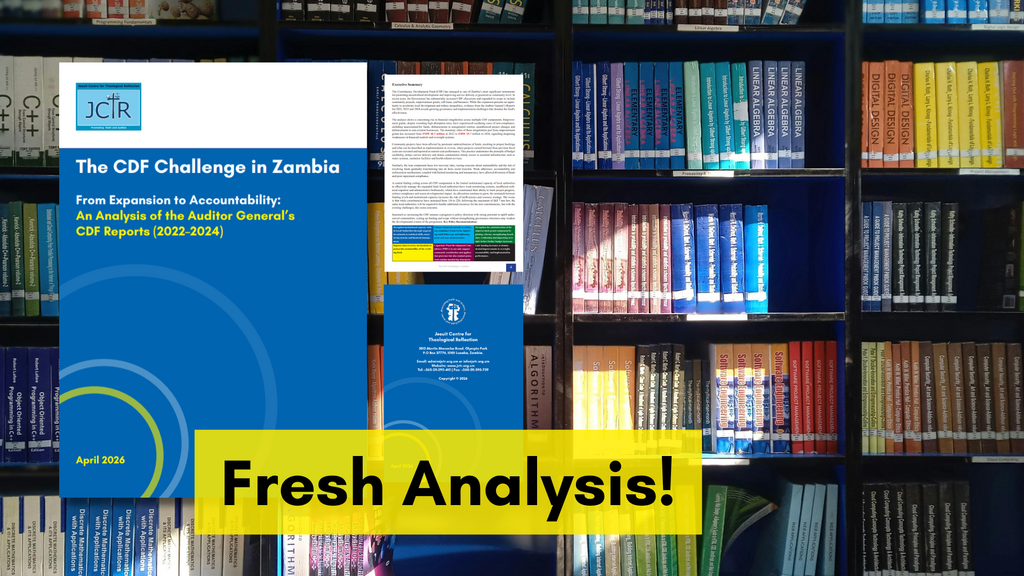
THURSDAY, APRIL 16, 2026, LUSAKA - Zambia’s Constituency Development Fund (CDF) has expanded significantly in recent years, becoming a central instrument for decentralised development and community-level service delivery. While increased allocations have created opportunities to address local needs, analysis by the Jesuit Centre for Theological Reflection (JCTR), based on the Auditor General’s Reports from 2022 to 2024, indicates that this growth has not been matched by corresponding improvements in accountability and implementation systems.
The findings point to persistent challenges across key components of the Fund. Financial irregularities have continued to rise, increasing from ZMW 18.7 million in 2022 to ZMW 25.7 million in 2024, reflecting ongoing weaknesses in financial controls and oversight . These include unaccounted-for funds, disbursements to unregistered or non-existent entities, and unauthorised changes to approved projects. At the same time, delays in project implementation remain a concern. In several instances, projects carried forward from previous years are completed and reported as part of current-year performance, creating a perception of progress while masking underlying inefficiencies in planning and fund disbursement. This has the effect of delaying new projects and slowing down service delivery to communities.
The loan component of the CDF also continues to underperform. Recovery rates remain low, with only about 10.6 percent of expected recoveries realised in 2023 and 17.0 percent in 2024 . Although there is some improvement, the overall performance raises concerns about the sustainability of the facility as a revolving fund. Without stronger enforcement and monitoring, the intended impact of supporting local economic activity is unlikely to be fully realised. These challenges persist despite resources being allocated for administration and oversight, with evidence showing that monitoring systems remain weak, affecting accountability and the quality of project implementation.
A central issue underlying these findings is the limited institutional capacity within local authorities to manage the expanded scope of the Fund. As allocations increase and responsibilities grow, gaps in technical expertise, monitoring, and administration become more evident. This creates a mismatch between the scale of funding and the systems required to manage it effectively.
The expansion of the CDF remains an important policy direction with the potential to support inclusive development. However, the evidence suggests that increasing allocations alone is not sufficient. Strengthening accountability systems, improving implementation processes, and building institutional capacity will be essential to ensure that the Fund delivers meaningful and timely benefits to communities.
The CDF is ultimately a public resource meant to serve communities. Strengthening its impact requires not only institutional reforms, but active citizen engagement. We invite you to share your experiences, insights, and recommendations on how the Fund can better promote transparency, accountability, and meaningful development outcomes.
Join the conversation in the comments below.

"A just Zambian society guided by faith, where everyone enjoys the fullness of life".