
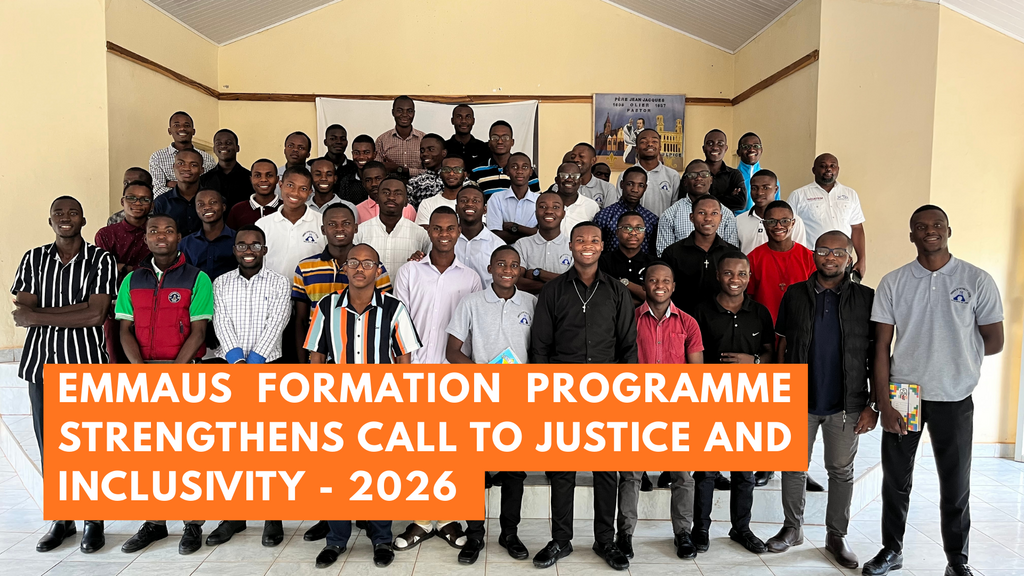
LUSAKA - From 9th to 11th February 2026, the Jesuit Centre for Theological Reflection (JCTR) facilitated a three-day formation programme at the Emmaus Spirituality Centre under the theme: “Inclusivity and Equity in the Call for Socio-Economic, Political and Environmental Justice.”
The formation brought together seminarians for theological reflection, social analysis, and pastoral discernment rooted in Catholic Social Teaching (CST). The programme integrated spiritual formation with pressing socio-economic realities in Zambia, offering participants a holistic understanding of faith in action.
Grounding Formation in Catholic Social Teaching
The programme opened with an overview of JCTR’s mission and an introduction to Catholic Social Teaching, social justice, and sustainable development. Participants explored how CST provides a moral framework for engaging issues of poverty, inequality, governance, and environmental stewardship.
In his presentation titled “The Significance of Catholic Social Teaching in My Formation as a Seminarian,” Dr Boyd Kapyunga Nyirenda, SJ, Deputy Director of JCTR, emphasised that CST is not optional in priestly formation. Drawing from Scripture and Church tradition, he highlighted key principles such as human dignity, the common good, solidarity, subsidiarity, and the preferential option for the poor.
He stressed that in Zambia’s context — marked by poverty, youth unemployment, corruption, and environmental vulnerability — future priests must be equipped to integrate faith with lived realities. CST, he noted, forms conscience, sharpens pastoral sensitivity, and prepares seminarians to serve as prophetic voices within their communities.
Building a Harmonious and Equitable Society
Sessions led by Sr. Lyempe examined peace, justice, and human rights within the context of human dignity and the common good. Discussions encouraged participants to reflect on the Church’s role in fostering inclusive societies where social, economic, and political systems serve all people, especially the marginalised.
The programme also addressed the Church’s responsibility in responding to climate change and environmental degradation. Participants were challenged to view environmental stewardship not only as ecological concern, but as a matter of justice, particularly for vulnerable communities most affected by climate shocks.
Servant Leadership in Church and Society
Dr Nyirenda further led a session on Servant Leadership: Understanding the Practices of Effective Servant Leadership. Rooted in Christ’s example — “the Son of Man did not come to be served, but to serve” — the session contrasted traditional models of authority with leadership grounded in humility, service, and empowerment.
Drawing parallels with the African philosophy of Ubuntu, he emphasised that authentic leadership in Zambia must prioritise integrity, accountability, and community-centred decision-making. Seminarians engaged in reflective discussions on how they can embody servant leadership in parishes, families, and broader national life.
Linking Faith to the Cost of Living Reality
A significant highlight of the programme was the presentation by Lombe Michael Kasanda from JCTR’s Social and Economic Development Programme on “Poverty and Vulnerability: Linking the Cost of Living (BNNB).”
Participants were introduced to the Basic Needs and Nutrition Basket (BNNB) and the Satellite Homes Survey (SHS), two key research tools used by JCTR to assess living conditions and inform advocacy.
The presentation revealed sobering realities:
Recent economic challenges — including drought, inflation, currency fluctuations, and energy constraints—have deepened vulnerability, particularly among female-headed households and urban poor communities.
By presenting concrete data, the session demonstrated how research strengthens advocacy for policies that uphold human dignity and reduce inequality. For seminarians, this connection between social analysis and pastoral mission underscored the practical application of CST in national development and poverty reduction.
Applying Catholic Social Teaching to National Development and Poverty Reduction
Micomizya Dieudonne’, JCTR's Faith & Justice Programme Officer, led a session on “Application of the Church’s Social Teachings in National Development and Poverty Reduction,” bridging theological principles with practical governance and policy realities.
The presentation underscored that Catholic Social Teaching is not abstract doctrine but a living framework capable of shaping national development strategies. Participants reflected on how principles such as human dignity, the common good, subsidiarity, and solidarity can guide public policy, economic planning, and social protection systems.
The session emphasised that poverty reduction must move beyond charity to structural transformation. Development efforts, Micomizya noted, should prioritise inclusive growth, equitable resource distribution, and participatory governance. When grounded in CST, national development becomes people-centred rather than profit-driven.
Seminarians were challenged to envision their future pastoral roles not only within parish life but also in shaping public discourse on governance, accountability, and social justice. The discussion reinforced the Church’s prophetic responsibility to advocate policies that protect the vulnerable and promote integral human development.
Communication, Media and Catholic Social Teaching
The session on Communication and Media was facilitated by Bernard Mwaba, Communications and Digital Engagement Officer. The discussion examined how communication functions as a tool for advocacy, accountability, and social transformation when rooted in Catholic Social Teaching. Participants reflected on how media shapes public perception of poverty, governance, climate change, and inequality — and how responsible communication can centre human dignity and amplify marginalised voices.
The session emphasised that communication within the Church is not merely informational but prophetic. When grounded in the principles of solidarity, the common good, and the preferential option for the poor, media engagement becomes a ministry of justice. Seminarians were encouraged to view communication as part of their pastoral responsibility — whether preaching, engaging communities, or contributing to public discourse.
Through practical examples drawn from JCTR’s advocacy work, including the Basic Needs and Nutrition Basket (BNNB), the session demonstrated how research-based communication strengthens social accountability and influences policy conversations.
Integrating Faith, Justice, and Action
Across the three days, plenary discussions, prayer moments, and interactive reflections fostered deep engagement with the theme of inclusivity and equity. The formation emphasised that social justice is inseparable from spiritual life. Prayer, study, and pastoral ministry must converge in concrete action for justice.
The programme reaffirmed that the Church’s social mission remains vital in Zambia’s current socio-economic and environmental landscape. By equipping seminarians with theological grounding, contextual analysis, and leadership principles, the Emmaus formation strengthened their readiness to serve communities with compassion, integrity, and courage.
As the programme concluded, participants were reminded that authentic faith calls for transformation — not only of hearts, but of structures. The call to justice is ongoing, and the responsibility to respond begins in formation.

"A just Zambian society guided by faith, where everyone enjoys the fullness of life".