
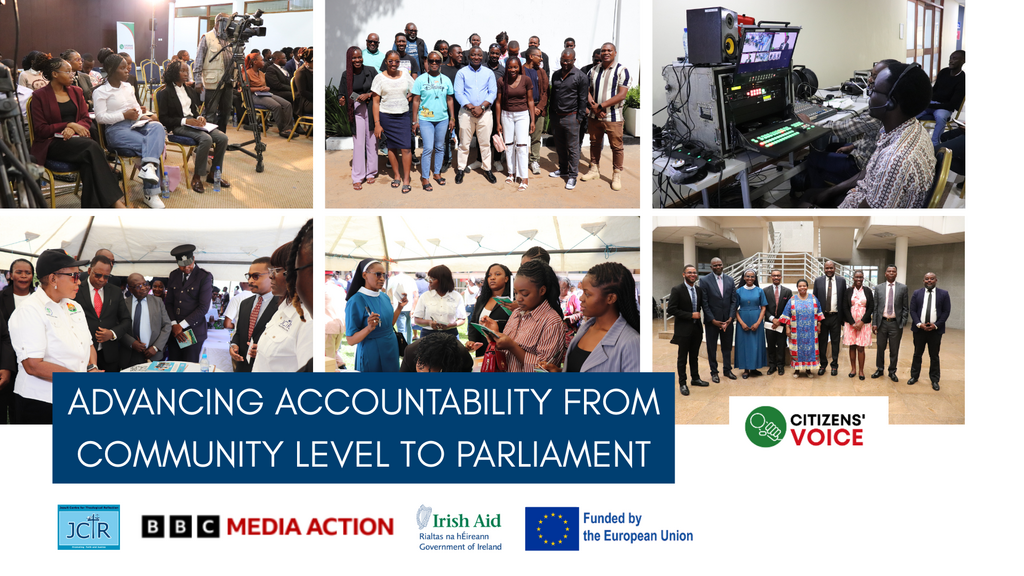
APRIL 21–26, 2026, LUSAKA - The Citizens’ Voice Expanded project, implemented by BBC Media Action in partnership with the Jesuit Centre for Theological Reflection (JCTR), with funding from the European Union and the Government of Ireland, delivered a dynamic and impactful week of governance and accountability activities from April 21–26, 2026.
Across national media platforms, training spaces, and the floor of Parliament, the week demonstrated how strengthened citizen participation, media engagement, and policy advocacy continue to expand civic accountability in Zambia.
The week began with JCTR’s participation in a panel discussion recorded for the Citizens’ Voice television programme and later broadcast on national television through ZNBC. The discussion focused on civic accountability, citizen engagement, and the role communities play in holding leaders and institutions accountable.
By showcasing these conversations on a national platform, the programme amplified the voices of community journalists and listening groups, reinforcing a core principle of the project: accountability belongs to citizens, and communities have both the right and the tools to demand transparency and responsiveness from public officials.
Midweek activities focused on the behind-the-scenes work essential to sustaining high-quality governance programming. BBC Media Action facilitated mentoring and post-production sessions with partner radio station teams, supporting lead producers in refining governance content and strengthening editorial standards.
The teams also undertook structured editorial planning sessions to identify priority governance issues for upcoming coverage across the project’s eight partner stations. This planning reflects the strengthened Year 2 model, which places stations and lead producers at the centre of accountability programming from issue identification through to public follow-up.
On Thursday, 23 April, JCTR facilitated a practical training session on Zambia’s Access to Information Act No. 24 of 2023 and the 2025 General Regulations.
Designed as a hands-on exercise rather than a lecture, the session guided community journalists and programme staff through completion of Form I—the formal legal instrument for requesting information from public institutions.
Participants worked through real governance issues they are actively pursuing and examined the practical enforcement mechanisms available under the law, including escalation pathways through the Human Rights Commission when requests are unlawfully ignored.
The training equipped journalists not only with legal knowledge, but with practical tools to strengthen evidence-based accountability reporting in their communities.
Friday’s full-day training at Fatmols Hotels marked one of the most substantial engagements of the week. Community journalists, lead producers, and partner organisation staff convened to review all nine social audits conducted under Year 1 of the project.
The review highlighted notable successes, including:
Participants also reflected on unresolved cases requiring structured follow-up.
JCTR and BBC Media Action then introduced the revised Year 2 social audit framework, which formally integrates radio stations and producers into every stage of the accountability process—from issue identification and investigation to on-air follow-up and closure.
A key deliverable presented was the completion of 12 Governance Issue Prioritisation Scorecards per station annually, creating a regular accountability rhythm through which communities assess elected leaders and public service delivery.
The day also featured a specialist training session led by MISA Zambia’s Austine Sitali on data journalism and investigative reporting, covering source verification, public finance tracking, use of CDF records and Auditor General reports, and overcoming barriers to information access.
Saturday, 26 April, marked the week’s most prominent public engagement as JCTR appeared before the Select Committee of the National Assembly to present oral and written submissions on the Electoral Process (Amendment) Bill, 2026 [N.A.B. 44 of 2026].
JCTR welcomed the proposed transition to a Mixed-Member Proportional Representation electoral system as a historic opportunity to address long-standing underrepresentation of women, youth, and persons with disabilities in Zambia’s political system.
However, JCTR also raised several substantive concerns requiring amendment before enactment, including:
These submissions reflect JCTR’s continued commitment to ensuring that electoral reforms strengthen, rather than weaken, democratic participation and accountability.
Simultaneously, members of the Citizens’ Voice Expanded team managed the project’s stand within the parliamentary precinct, distributing IEC materials and demonstrating the Citizens’ Voice Scorecard used by communities to assess elected officials and local service delivery.
A particularly notable moment came when National Assembly Speaker
Nelly Mutti visited the stand and expressed interest in the project’s accountability work, noting her anticipation of receiving the programme’s report.
Her visit served as high-level recognition of the growing significance of community-driven accountability mechanisms in strengthening democratic governance.
The week of 21–26 April underscored the multidimensional nature of accountability work under the Citizens’ Voice Expanded project — from grassroots capacity building and investigative journalism training to national policy advocacy and parliamentary engagement.
As Year 2 gains momentum, the project continues to demonstrate that when citizens are informed, organised, and equipped with practical tools, accountability becomes not merely an aspiration, but a lived democratic practice.
A slide through our gallery of activities for the week:
Taking Accountability to the National Stage
Reviewing Progress & Preparing for Year Two
Parliamentary Engagement on Electoral Reform
Citizens' Voice on Display at Parliament

"A just Zambian society guided by faith, where everyone enjoys the fullness of life".