Lusaka, Zambia – July 2025
The Jesuit Centre for Theological Reflection (JCTR) has released a comprehensive and thought-provoking critique of the Government’s proposed constitutional amendments published in Gazette Notice No. 539 of 2025. While Government has positioned these 20 proposed amendments as "non-contentious" and largely procedural, JCTR’s analysis exposes their profound implications on Zambia’s democratic architecture, decentralisation framework, and the fundamental tenets of development.
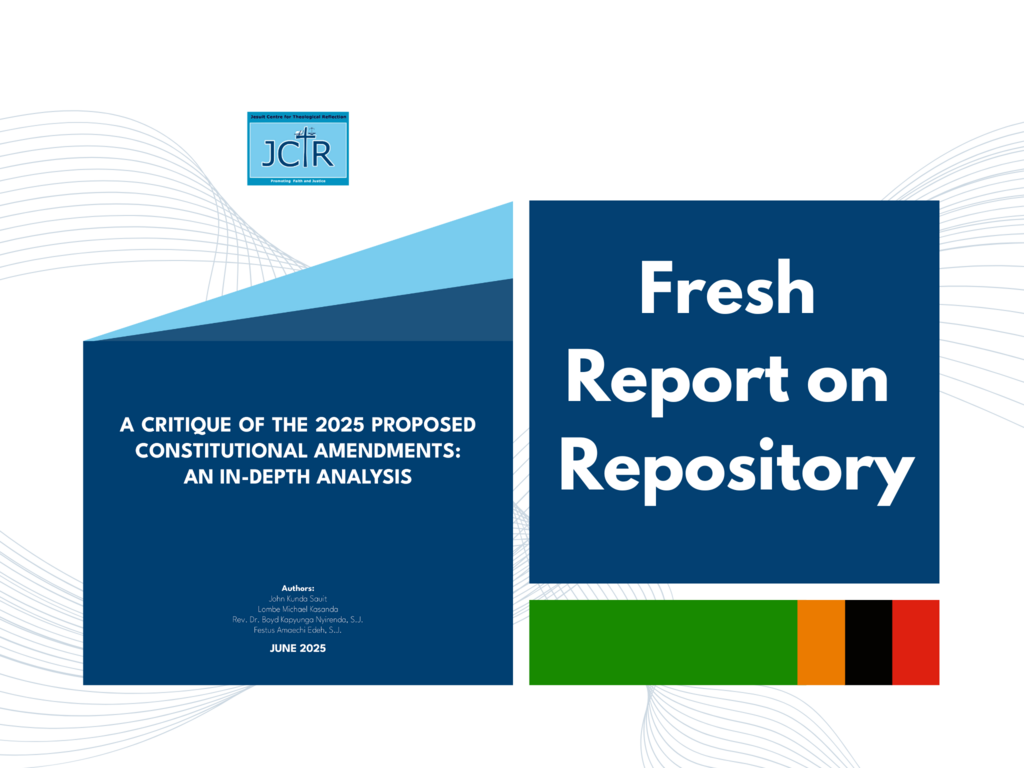
Titled “A Critique of the 2025 Proposed Constitutional Amendments: An In-Depth Analysis,” the document interrogates the philosophical, theological, legal, and political rationale behind the proposed changes and challenges their coherence with Zambia’s development priorities and constitutional values.
Understanding the Scope of the Amendments
The proposed amendments affect several critical areas of governance, including:
- Electoral reform and the structure of the National Assembly
- Representation of women, youth, and persons with disabilities (PWDs)
- Roles of Members of Parliament and their re-integration into Councils
- Dissolution timelines and tenure of ministers
- Delimitation of constituencies and expansion of parliamentary seats
- Executive powers over nominations and key appointments
These changes are presented as technical adjustments to address governance “lacunae,” but JCTR argues that they carry deeper consequences — many of which threaten to erode democratic safeguards, compromise accountability, and undermine the participatory spirit of the Constitution.
Key Concerns Raised by the Analysis
- A Shift Towards Executive Dominance
The proposed increase in presidentially nominated Members of Parliament from 8 to 10, and the move to entrench party-controlled seat replacements instead of by-elections, raise serious concerns about overreach. These changes concentrate influence in the Executive, reducing citizens’ direct say in who represents them and weakening Parliament’s independence and oversight function. - Undermining the Doctrine of Separation of Powers
Proposals to reintroduce MPs into local councils contradict the 2016 reform that sought to professionalise local government and depoliticise developmental spaces. Such a reversal threatens the integrity of both local autonomy and parliamentary oversight, as MPs would be tasked with monitoring policies they are themselves implementing — an inherent conflict of interest. - The Threat of Politicised Decentralisation
Instead of strengthening Zambia’s devolution agenda, the amendments risk recentralising power under political actors. The argument that more constituencies are needed to distribute the Constituency Development Fund (CDF) more equitably is challenged by the analysis, which notes that equitable development is better achieved through creation of more districts — a process that does not require constitutional change. - Selective Representation Measures
The shift to a Mixed Member Proportional (MMP) electoral system — intended to increase representation of women, youth and PWDs — is acknowledged as progressive in principle, but the quotas proposed are lower than regional and international standards. Moreover, these seats are tied to party performance, effectively excluding independents and reinforcing elite party control rather than fostering broad inclusivity. - Term Limit Removal as a Dangerous Precedent
The proposed removal of mayoral term limits is flagged as a precedent that could lead to the eventual removal of presidential term limits. JCTR insists that all elective offices — including MPs and councillors — should be bound by term limits, to protect against corruption, promote leadership renewal, and safeguard democratic integrity.
A Theological and Developmental Perspective
Grounded in Catholic Social Teaching (CST) and Zambia’s identity as a Christian nation, JCTR’s analysis highlights the primacy of human dignity, participation, subsidiarity, and solidarity in governance. It insists that development must be people-centred, not party-centred. The critique references Pope Paul VI’s encyclical Populorum Progressio, which affirms that “development is the new name for peace.”
JCTR argues that most of the amendments fall short of meeting Zambia’s current developmental needs — rising cost of living, high youth unemployment, poor public service delivery — and instead focus on re-engineering the electoral and political order in favour of control, not empowerment.
Methodology Matters: Process Is as Important as Content
Beyond content, the critique highlights flaws in the amendment process itself. Despite procedural legality, the process lacks broad-based public consultation, transparency, and inclusive stakeholder engagement — all of which are essential for any constitutional reform to be legitimate and sustainable.
In disregarding the 2019 Delimitation Report and fast-tracking amendments through a technocratic and executive-driven process, the Government risks repeating past failures where constitutional amendments were either rejected, ignored, or rendered ineffective due to lack of ownership by the people.
What JCTR Recommends
The analysis concludes with several pointed recommendations, including:
- Suspend or withdraw proposals that weaken oversight and accountability.
- Abandon piecemeal amendments in favour of a holistic, people-driven constitutional reform process.
- Engage stakeholders meaningfully — including political parties, CSOs, religious bodies, and citizens — in dialogue across all provinces.
- Align constitutional amendments with Zambia’s development agenda, prioritising access to services, equity, and transparency.
- Preserve term limits for all elected positions as a safeguard against power entrenchment.
A Call to the Nation
JCTR’s message is clear: constitutional reform must not serve political expedience but should instead reflect the hopes, needs, and voices of the Zambian people. It must be grounded in values that uphold justice, dignity, equity and peace.
“The Constitution is not merely a legal document — it is a social contract. When amended, it must serve both current and future generations.”