
STORY OF CHANGE
Thursday, January 29, 2026
SOLWEZI, NORTH-WESTERN - For many years, residents of Mbonge community in Solwezi District lived with the daily reality of unsafe water and inadequate public services. The Kisengesenge Stream, once a vital source of water for households, became increasingly contaminated — posing serious risks to public health, livelihoods, and dignity. Despite repeated concerns raised by the community, these issues initially received little attention from responsible institutions.
This began to change through JCTR’s Fighting Inequality Project, implemented with support from NCA–DCA, which placed community empowerment, social accountability, and citizen-led advocacy at the centre of development efforts.
Empowering Communities to Demand Accountability
Under the Fighting Inequality Project, JCTR facilitated capacity-building workshops on social accountability and advocacy, equipping community members with the skills to document challenges, understand institutional mandates, and engage duty bearers effectively through a Human Rights Based Approach (HRBA). Community members learned how to gather evidence, articulate their concerns clearly, and participate meaningfully in dialogue with both state and non-state actors.
This empowerment marked a critical shift — from passive endurance of poor conditions to organised, informed, and collective action.
Securing Safe Water through Sustained Advocacy
Armed with new knowledge and confidence, residents of Mbonge organised themselves and initiated structured engagement with key stakeholders, including Kansanshi Mining Plc, the Zambia Environmental Management Agency (ZEMA), and the Water Resources Management Authority (WARMA). Their advocacy centred on the contamination of the Kisengesenge Stream and the urgent need for safe, alternative water sources.
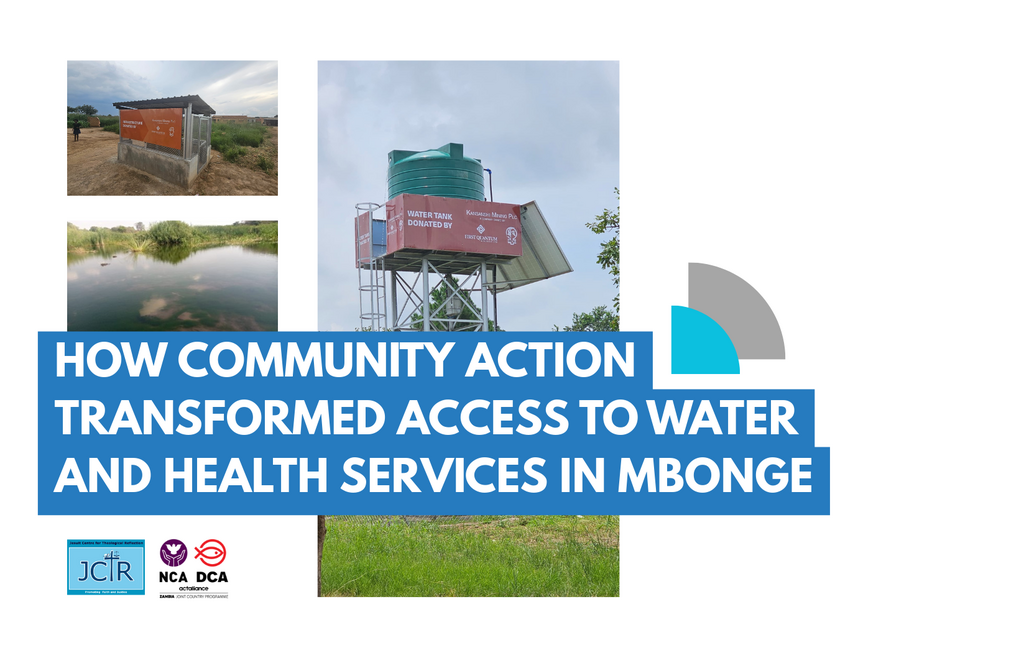
As a result of this sustained engagement, independent water testing was undertaken, and immediate interim measures were introduced. Kansanshi Mining Plc began supplying clean water to affected households through water bowsers. More importantly, a long-term solution was later implemented through the drilling of boreholes and the installation of a water reticulation system with water kiosks spaced approximately every 100 metres across the community.
This intervention significantly reduced reliance on contaminated water sources and restored access to safe, reliable water — improving health outcomes, easing the burden on women, children, and the elderly, and strengthening community resilience.
Improving Health Services at Mbonge Clinic
The culture of collective action extended beyond water issues to other essential services. For many years, Mbonge Clinic operated under severe strain, with only two health workers serving the entire catchment area. Long waiting times and limited access to care were common.
Through continued community monitoring and evidence-based engagement with the District Health Office, residents consistently raised the staffing gap as a priority concern. Their persistence paid off. Staffing levels at the clinic increased from two (2) to seven (7) health workers, leading to reduced waiting times, improved service delivery, and better quality healthcare for the community.
A Story of Change and Dignity
The experience of Mbonge community demonstrates that inequality is not inevitable when communities are empowered to act. By strengthening citizen voice and enabling constructive engagement with duty bearers, the Fighting Inequality Project transformed long-standing grievances into tangible, life-improving outcomes.
This story of change affirms JCTR’s commitment to promoting social justice, accountability, and human dignity, and shows how informed, organised communities can shape development processes that respond to their real needs.
At its core, the Mbonge experience is a reminder that sustainable development is not delivered to communities — it is achieved with them.

"A just Zambian society guided by faith, where everyone enjoys the fullness of life".