
TUESDAY, JANUARY 20, 2026
LUSAKA - Zambia’s agricultural future is increasingly shaped by the realities of climate change, rising input costs, and persistent food insecurity among rural and peri-urban communities. In response to these challenges, the Jesuit Centre for Theological Reflection (JCTR), with support from the Scottish Catholic International Aid Fund (SCIAF), has undertaken complementary research aimed at strengthening the case for agroecology as a pathway to climate resilience, food justice, and sustainable livelihoods.
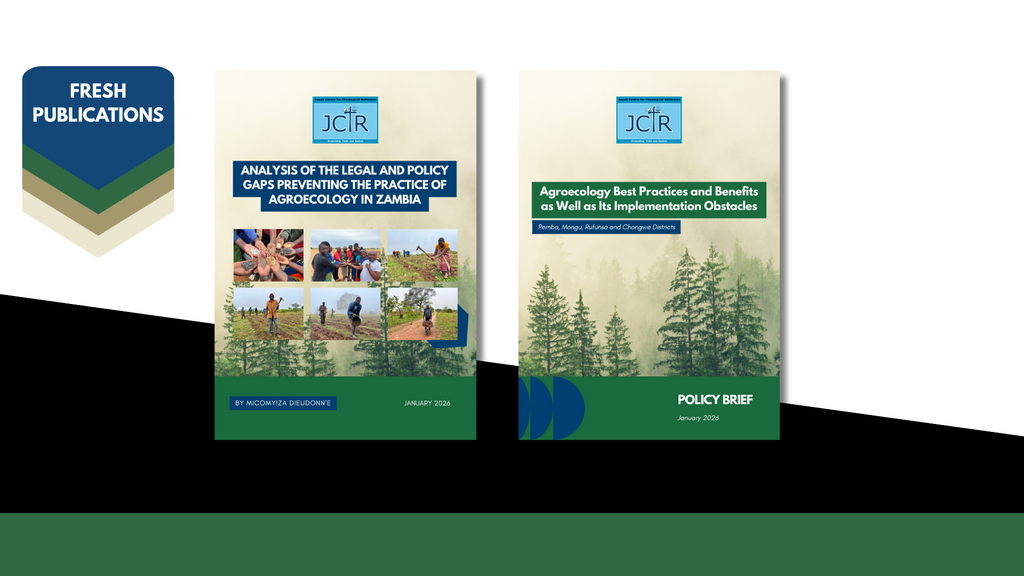
This blog summarises two key publications emerging from this work:
Together, the documents provide both a national policy perspective and a grounded account of farmers’ lived realities.
Agroecology applies ecological principles to agricultural systems, prioritising soil health, biodiversity, water conservation, local knowledge, and reduced dependence on costly external inputs. It offers a viable response to climate change by strengthening resilience, improving food and nutrition security, and supporting environmentally sustainable production systems—particularly for small-scale farmers.
Despite these benefits, agroecology remains marginal within Zambia’s formal agricultural policy and legislative environment.
The analysis reveals that Zambia lacks a dedicated agroecology policy and that existing laws and policies do not explicitly recognise or promote agroecological approaches. While several frameworks reference sustainability or climate-smart agriculture, they largely favour industrial and input-intensive models of production.
Notable gaps include:
Overall, the analysis concludes that Zambia’s current policy environment does not sufficiently support the transition to agroecological food systems, despite alignment opportunities with the 2030 Agenda for Sustainable Development, the 8th National Development Plan, and regional climate commitments.
The policy brief complements the national analysis by examining agroecology at community level across four districts: Pemba, Mongu, Rufunsa and Chongwe. Using focus group discussions and key informant interviews, the study assessed farmer practices, policy awareness, and practical constraints.
Key insights include:
The brief confirms that while farmers are open to sustainable approaches, the absence of supportive policy, financing, and institutional backing significantly limits wider adoption.
Both documents converge on a clear conclusion: Zambia urgently needs a coherent, explicit policy and legislative framework that recognises and promotes agroecology as central to food security, climate resilience, and social justice.
Key recommendations include:
For readers seeking deeper analysis and detailed recommendations, the full publications are available via the buttons below.
These resources are intended to support policymakers, civil society, faith-based organisations, researchers, and communities in advancing agroecology and food justice in Zambia.

"A just Zambian society guided by faith, where everyone enjoys the fullness of life".